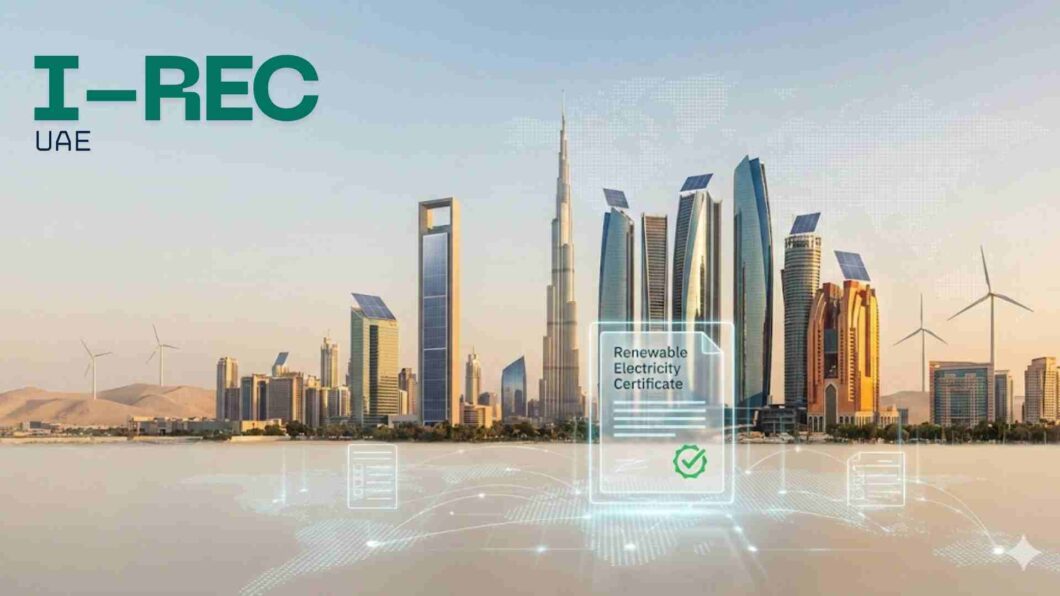
Farnek Becomes an Approved I-REC Provider Under the Evident Registry: What It Signals for Renewable Electricity Claims in the UAE (and Beyond)
Farnek, a UAE-based smart and green facilities management company that also provides carbon offset solutions, has been officially registered under the Evident Registry as an approved provider of I-RECs (International Renewable Energy Certificates). The announcement positions Farnek to issue and provide certified I-RECs through a formal registry pathway, strengthening the infrastructure for renewable electricity attribute claims in the region.
This milestone matters because it sits at the intersection of three fast-moving trends: (1) rising corporate pressure to demonstrate credible Scope 2 decarbonisation, (2) tightening scrutiny of green claims and audit evidence, and (3) a market shift toward higher-integrity renewable electricity sourcing—especially for large electricity consumers and real estate portfolios.
1) What “Approved I-REC Provider” Means in Practice
I-RECs are market-based instruments that certify the renewable attributes of electricity generation, where one I-REC corresponds to one megawatt-hour (MWh) generated from renewable energy sources. In other words, they are an attribute-tracking mechanism designed to help organisations credibly substantiate renewable electricity usage claims.
Being registered as an approved provider under a registry framework signals that the provider can operate within a recognised issuance and documentation process—something that becomes increasingly important as buyers, auditors, and stakeholders demand:
- Clear evidence trails (issuance → ownership → retirement/cancellation)
- Consistent documentation that aligns with reporting needs
- Traceability that reduces greenwashing risk in procurement claims
2) The EKOenergy Agreement: Raising the Integrity Bar for Eligible I-RECs
In a separate but complementary step, Farnek also signed an agreement with EKOenergy, the international renewable energy ecolabel. The announcement notes that the EKOenergy label can be applied to eligible I-RECs that meet additional environmental and sustainability criteria, and that it is required for LEED Zero certification.
For many buyers—especially in real estate and large corporate portfolios—this is not a small detail. It creates a clearer pathway from “we bought certificates” to “our procurement meets a higher-integrity label and fits a recognised building certification requirement,” improving the credibility of claims under advanced green building standards.
3) Emirates Carbon: Centralising Procurement, Evidence, and Scope 2 Calculations
The announcement also highlights Farnek’s Emirates Carbon platform as the delivery layer that centralises procurement and supporting evidence. It is described as a free, open-access platform that provides carbon footprint calculations and direct access to offset programmes, certified carbon credits, and I-RECs.
Beyond access, the operational value is in workflow and audit readiness. According to the announcement, the platform centralises:
- Certificate procurement and documentation
- Project information and traceability
- Automated Scope 2 emissions reduction calculations
- Integration with dashboards for reporting and verification via Farnek’s CarbonTek enterprise solution (tracking Scope 1, 2, and 3 emissions across operations and supply chains)
For organisations trying to move from ad-hoc certificate purchases to a repeatable and verifiable program, these features are often the difference between “marketing claim” and “defensible reporting.”
4) Why This Matters for Scope 2 Strategy in the UAE
Farnek explicitly frames the approval as enabling corporate decarbonisation aligned with the UAE Net Zero 2050 Strategy, and as a credible mechanism for Scope 2 reductions. The announcement also argues that I-RECs can help organisations bridge gaps where renewable adoption is constrained by infrastructure, regulation, or limitations in on-site technology.
Just as importantly, it links I-RECs to governance and credibility: transparency and traceability are positioned as tools to reduce greenwashing risk and to support audit-ready ESG reporting.
In markets where renewable procurement is accelerating, these “governance features” are no longer optional extras—they are increasingly the product.
5) A Buyer’s Checklist: What to Verify When Procuring I-RECs
Even with reputable providers and recognised registries, buyers should still perform basic due diligence to ensure the procurement matches the intended claim. Here is a practical checklist you can apply:
- Traceability and documentation
- Can you access the full evidence chain and retirement/cancellation proof?
- Geography and sourcing priority
- Are you prioritising local renewable sources where possible, and using international certificates only when needed? (The announcement notes prioritisation of UAE sources where possible, with international access when local availability is limited.)
- Reporting alignment
- Does the procurement support your reporting framework expectations (e.g., internal audit, ESG reporting readiness)?
- Scale and portfolio fit
- Can the provider support your required volumes—from small annual needs to thousands of MWh?
- Quality uplift options
- Do you need an ecolabelled option (such as EKOenergy-labelled eligible I-RECs) to meet higher-integrity standards or certifications (e.g., LEED Zero)?
6) Looking Ahead: From Annual Attributes to Granular Credibility
The announcement reinforces a direction the wider market is already moving toward: credibility increasingly depends on how renewable claims are evidenced, not only on whether certificates are purchased.
I-RECs remain an MWh-based attribute instrument, and many corporate buyers still operate with annual matching logic. At the same time, market conversations are shifting toward more granular approaches (e.g., closer time-matching between consumption and renewable generation), because stakeholders are asking tougher questions about the real-world meaning of “100% renewable” claims.
In that context, provider approval, registry alignment, and optional integrity layers (such as ecolabel requirements) become foundational building blocks. They do not automatically make a claim “24/7” or “granular,” but they do strengthen the documentation architecture that future, stricter claim regimes will depend on.
Conclusion
Farnek’s registration as an approved I-REC provider under the Evident Registry, combined with its agreement with EKOenergy and the launch of the Emirates Carbon platform, is best understood as a package: issuance capability + integrity layer + evidence and reporting infrastructure.
For organisations sourcing renewable electricity attributes in the UAE and internationally, the announcement signals a continued market move toward scalable, traceable, and audit-ready procurement—where certificates are not treated as a standalone purchase, but as part of a defensible Scope 2 and ESG reporting system.